Thursday, May 19, 2016

Agent P teaches Pronouns

My students were having a problem remembering what a pronoun is and frankly I couldn't remember what they were off the top of my head when they asked. So I made them an anchor chart starring Perry the Platypus aka Agent P.

As I always tell my students, he may not be perfect but I tried my best. Anyway, I started the poster with the definition of what a pronoun is. We talked about it and I gave a few examples, then had the children come up with some examples and write them on the poster. I thought it'd be more meaningful if they got to help me make it instead of me just listing a bunch of words to them.

What Time Is It?

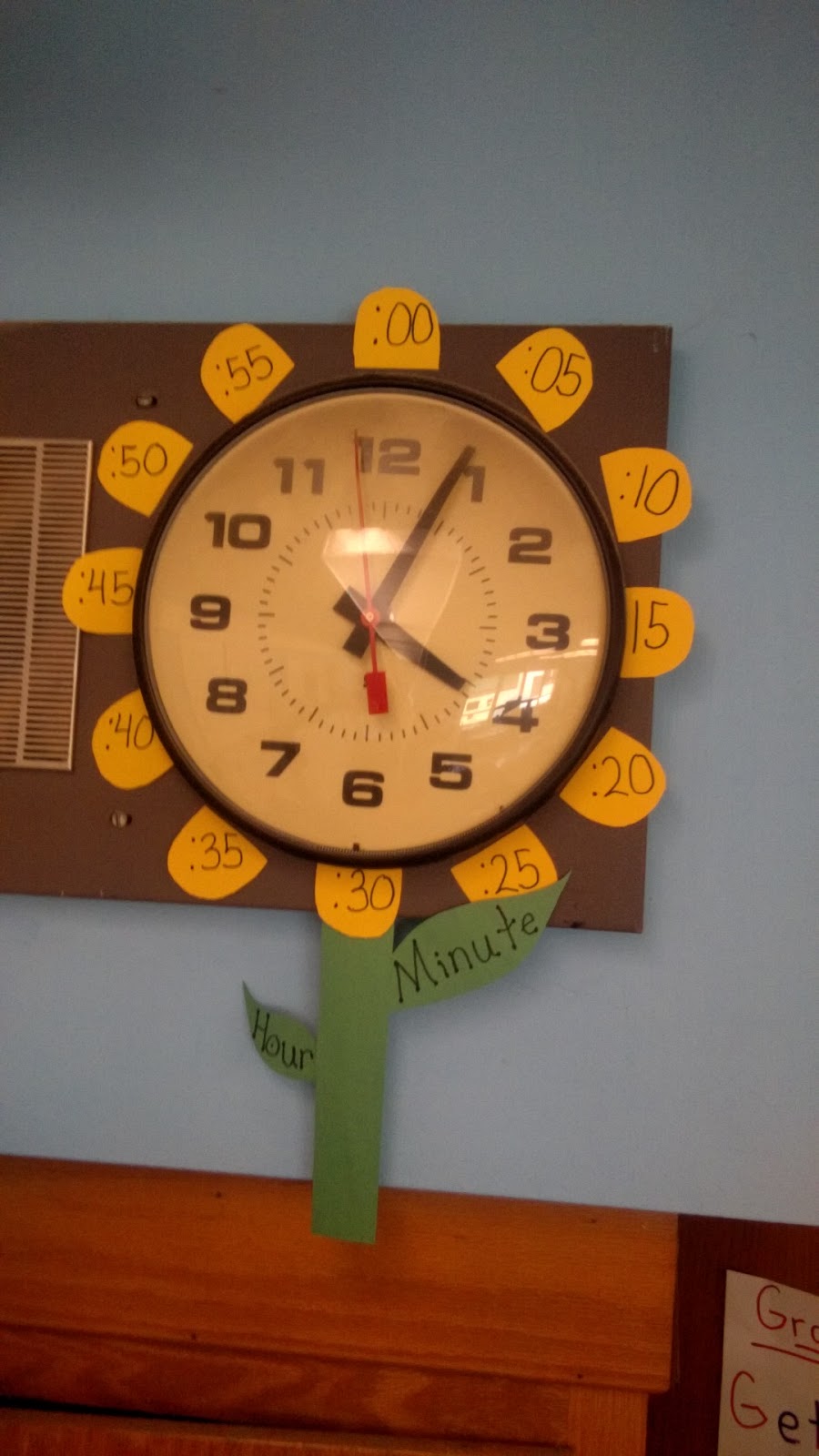
I decorated the classroom clock to look like a flower in order to help the students with telling time. In a way I feel like it's cheating but, help them get the skill now, they'll be able to do it with ease later.

I'm not afraid of heights but I was very nervous getting up on a ladder to hang these up. Particularly since the teacher I'm in for is out with a broken foot she got from climbing on something in her classroom and falling.

Anyway the flower serves two purposes. One to look cute cause it's spring time. And two each pedal represent the minutes on the clock, but the leaves on the stem are strategically showing that the hour hand and minute hand are different lengths.

Saturday, May 14, 2016

Author's Purpose

In a few days I will be taking the students to see Freckleface Strawberry. So the teacher I'm in for asked me to do a lesson on author's purpose using the story. Of course I came back with another anchor chart (Damn Danielle back at it again with the dope anchor charts).

I teach my students that "easy" is a math swear word, but in this case we'll make an exception. To help remember the parts common answers to "Why did the author write this story?" we say "Author's Purpose is Easy as Pie" but then I decided to add "Tea" as well.

So the choices are persuade, inform, entertain or teach also known as PIE with Tea.

After we read the story once to get the gist of it, we went over the choices again. Then we listened to the story again and the students wrote on post it notes which one they thought was the author's purpose and why. Then came up and stuck their post it on their choice.


As you can see most thought the purpose was to teach. However I preset them that there could be more than one right answer and just because the majority were on one choice doesn't mean their answer is wrong and to be confident in what they wrote and thought.

Suffixes

So back to second grade we go. I'm still in for that teacher that broke her foot. I know I'm posting all of these on the same day but that's just because this is the first free minute I've had, they didn't all take place on the same day.

Anyway during one of the stories we read this week the associated skill was suffixes so I made yet another cute chart to talk about suffixes and how they change the meaning of a word.

We talked about how when using a suffix you add it to a base word and it changes the meaning of the original word.

  1. Slow + ly = slowly "To do something in a slow way"
  2. Hope + ful = hopeful "To be full of hope"
  3. Teach + er = teacher "A person who teaches"
  4. Tall + er = taller "I am taller than my son" (enforce that it is important to compare to something. I got a lot of "The car is heavier" and "The teacher is taller" ... ok heavier than what? taller than what?)
  5. Visit + or = visitor "A person who visits"
  6. Child + ish = childish "To be like a child"

Paragraph Organization

While working with a fourth grader I noticed she could work on her paragraph structure and organization. So I again busted out my fancy anchor chart making skills to do the typical hamburger paragraph. I also added some transition words to the side to help remind the students of words they can use to help.

A good paragraph needs:
  1. A topic sentence
  2. At least 3 good details
  3. A good closing sentence
  4. and for fourth grade at least 6-8 sentences

Capitalization

During one of my lessons I realized a fourth grader I was working with could use a reminder of when to capitalize letters when writing so I wrote a lesson for her about it. We started with a paragraph I had written, full of purposeful capitalization mistakes. We read the paragraph together, then went through it sentence by sentence. She located each capitalization error, then replaced it with the proper letters using post it notes.

 Some of them were obvious to her, while others were a struggle which brings me into my next lesson but we'll talk about that later. She was able to tell that "I" needed to be capitalized but unable to tell me why besides that it looked funny. She was very engaged however, she even asked if I would write her a new paragraph so we could do it again!

Main Idea and Details

While working with a fourth grader for a graduate school assignment we discussed finding the main idea and details in a story. We talked about why good readers find the main idea. We read the first chapter and a half of Brittany the Basketball Fairy by Daisy Meadows.


We used this fancy anchor chart I made to talk about it. Why do readers find the main idea? How do good readers find the main idea?


After the reading of the story as well as a few comprehension questions. My student filled out this graphic organizer identifying the main idea and 3 details supporting her main idea.


She didn't realize she was supposed to write each detail in one box at first. :-P